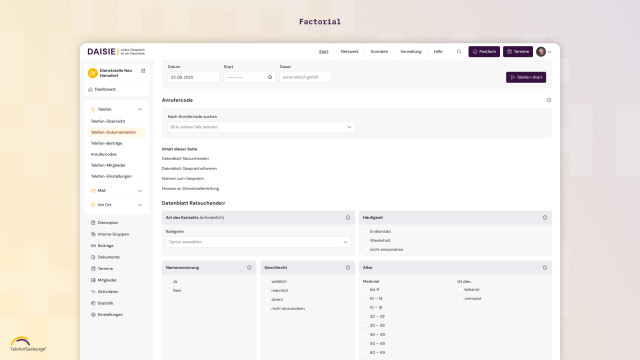
DAISIE - Digital Operating System for the TelefonSeelsorge
Development of a digital operating system for efficient organizational management based on Drupal for the nonprofit foundation Telefonseelsorge e.V. in Germany.
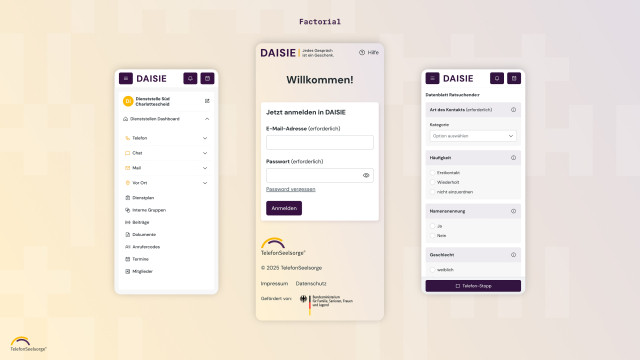
TelefonSeelsorge provides a publicly accessible service offering anonymous, personalized, and free counseling via phone, email, and chat for people suffering from loneliness, grief, suicidal thoughts, and other mental health conditions. Each year, approximately 8,000 staff members—about 7,700 of whom are volunteers—handle up to 1.5 million contacts with people seeking advice. The services offered by the approximately 100 regional offices range from telephone and digital services (e.g., chat, email, KrisenKompass) to local counseling centers in nearly 20 German cities. The documentation of these counseling sessions is used for statistical analysis of the underlying issues, in order to derive measures for planning counseling services and training programs.
Case Description
Given the great importance and growing demand for this free support service in Germany, TelefonSeelsorge urgently needed a modernized solution. Staff and volunteers were increasingly overwhelmed by administrative tasks, preventing them from focusing on their core mission: providing personal counseling to those seeking help. In addition, many team members and volunteers were not yet integrated into the digital system, meaning they lacked access to important documents and information. Furthermore, the legacy system suffered from frequent performance issues and system outages, making it difficult for the extensive network of counselors to reliably access important resources, especially when working remotely. On top of that, important processes such as human resources management, shift scheduling, and appointment coordination were handled manually, which placed an additional burden on daily counseling work.
Over the course of the project, TelefonSeelsorge, in collaboration with Factorial, developed a complex decoupled solution based on Drupal for the backend and Vue.js for the frontend, with the goal of digitizing day-to-day administrative tasks for thousands of counselors, thereby enabling them to refocus their efforts on supporting those in need.
Project Goals
As part of the project, the objectives were linked to four areas of the Telephone Counseling Service’s work:
Organization: Flexible coordination of the daily work of the Telephone Counseling Service and its volunteers, including shift scheduling, appointment coordination, and event management. In addition, the system is designed to provide easy access to relevant information and documents at the regional and national levels in order to improve collaboration and better document interactions with those seeking advice.
Counseling Documentation and Support for Those Seeking Help: The new system is designed to enable counselors to provide more efficient support to those seeking help via phone, chat, email, and local counseling centers. To this end, interactions with those seeking help should be standardized through the structured recording and categorization of all communication channels (phone, chat, email) and prepared for statistical analysis.
Communication: Providing a central hub for networking within the organization as well as for nationwide collaboration between staff and volunteers via a messaging service. Additionally, facilitating topic-specific collaboration in individual focus groups.
Employee Management: Centralized storage of master data; assignment of responsibilities and associated tasks based on role management to structure work organization and support global administrative activities.
Results
The newly developed digital operating system provides a new central platform for simple, fast, and efficient organizational collaboration.
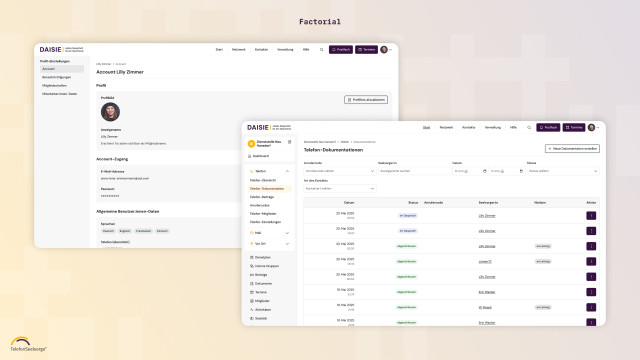
User Guidance (Usability): The new platform enables employees and volunteers to complete their tasks more quickly and efficiently thanks to intuitive, optimized user guidance. Built-in help functions and context-sensitive information messages help significantly reduce user errors. A clear, well-structured interface provides a comprehensive overview of every consultation request, including discussion topics, user details, and current status. Tasks are clearly categorized—e.g., “new,” “in progress,” or “awaiting approval”—and visually highlighted with color-coded labels. This not only improves process efficiency but also increases transparency within the team, thereby promoting seamless collaboration.
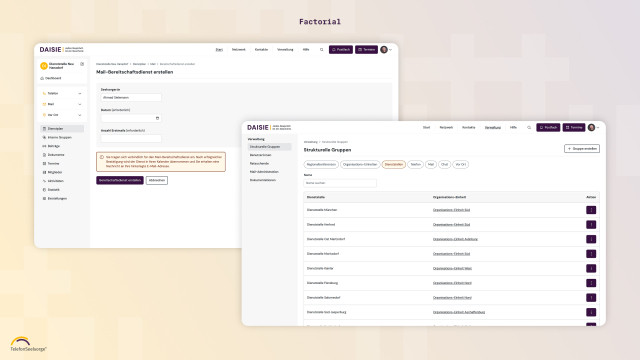
Workplace Management and Collaboration: At the heart of the system is the Group Module, which assigns users to specific groups based on their work area and regional focus. This enables quick access to relevant information and resources tailored to their responsibilities. Regional offices can customize their digital environment by configuring contact types and distinguishing between categories such as advertising, trolling, emergency calls, or genuine counseling requests. This not only categorizes incoming requests but also improves the quality of analyses and reports.
Automatically documented conversations can be analyzed and clustered, providing valuable insights into the reasons for contact and revealing patterns in the distribution of mental health issues among users. These insights are available in real time and support both short-term responses and long-term reporting, including annual evaluations.
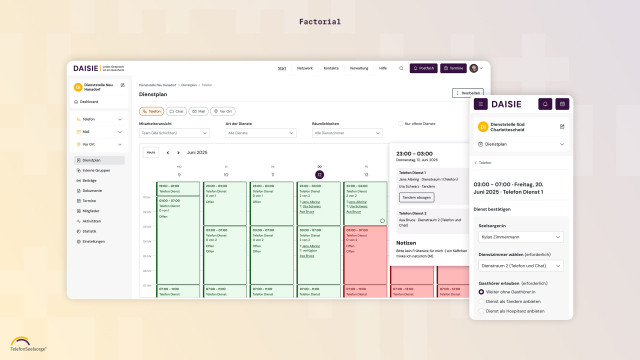
The system also features an integrated intranet that displays all team members along with their roles and availability status. For fast internal communication, the platform uses the Drupal Mattermost integration, which enables quick, direct exchanges between employees. Volunteers and staff can easily enter their availability into the system, ensuring flexible, efficient scheduling and better coverage of shifts.
In addition, the platform supports internal and regional event management, allowing the central administration to plan and promote training and continuing education opportunities. Overall, these features significantly reduce administrative burdens and enable employees to handle more consultation requests than before.
Given the ongoing shortage of skilled professionals in psychiatric care in Germany, the optimization of limited resources is a critical success factor that this system has been proven to fulfill.
System Availability: Access to important documents and the ability to interact with the system (scheduling appointments, etc.) are crucial, especially for employees who use the system while working in the field. Thanks to an optimized server setup, the new system offers a more powerful and stable platform. It also enables the system to handle a growing number of users and data, improves the system’s accessibility (WCAG 2.1 AA), and reduces the time to interaction.
Future-proofing: The new solution provides a scalable foundation for the organization’s future growth. The system was developed with flexibility in mind and supports phased expansions such as the integration of video-based remote counseling, the implementation of AI-powered features, and the automation of additional processes to further increase efficiency and service capacity.
Challenges
One of the biggest challenges was reconciling the complex business logic of the telephone counseling service with a high degree of customization while ensuring the stability and accessibility of a system used by thousands of employees and volunteers across the country.
To achieve this, a thorough business analysis was conducted at the outset, which included an assessment of the limitations of the previous system, interviews with key stakeholders, and a technical audit. This comprehensive groundwork formed the basis for the strategic approach to both the system architecture and usability. During the subsequent requirements analysis, the features were carefully refined and, in some cases, redesigned to align with real-world business processes and use cases.
Another challenge was driving the relaunch forward without disrupting the important daily work of employees and volunteers. Their ongoing involvement was essential to promote user adoption and validate the direction of development. To ensure this, the project team held several rounds of presentations in which hundreds of employees were informed about the progress of development—this ensured transparency, gathered feedback, and strengthened coordination throughout the entire process.
For more information about the project visit www.factorial.io